


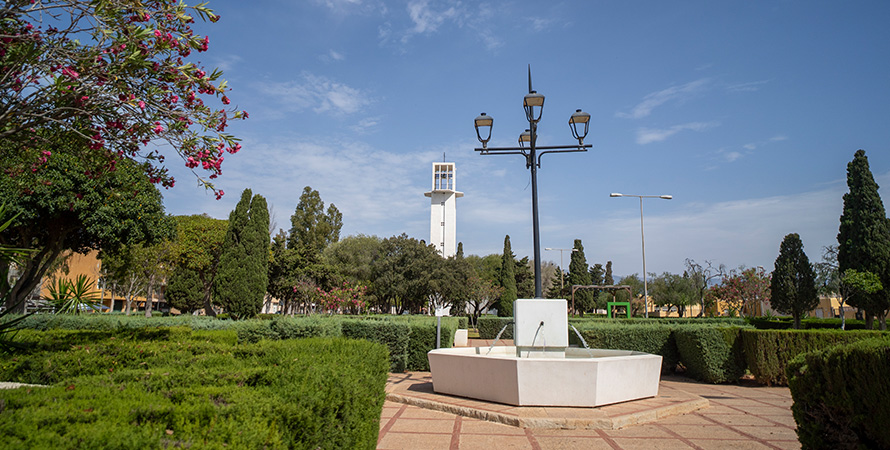
El Solanillo Colonisation Village
Stop11
The colonization settlement El Solanillo is a unique settlement that was part of an ambitious urban project, created by the National Institute of Colonization next to the old ponds of the Poniente Salt Flats.
This project was created to improve the living conditions of the agricultural population and provide a new home for hundreds of families in response to the social and economic problems of the countryside after the Spanish Civil War. El Solanillo was designed by the Almerian architect Francisco Lagle Granados in 1968 and consists of 44 homes. It is the only village in the province of Almería whose layout includes independent streets for vehicles with access to agricultural outbuildings. Furthermore, it features the construction of a buried tank for water supply and another elevated one as two independent elements, a unique example.
Walking through the streets of this settlement, one observes an architecture built with simple materials such as render or lime and the necessary facilities for social life. The houses with their straight lines and white volumes are arranged in an orderly fashion around central points such as the square, the school building or the church. The latter stands out because the architect placed it in the center of the settlement and made it prominent with a high bell tower, turning it into a landmark in the arid and monotonous landscape.
This settlement is much more than a collection of houses. It is a historical document in stone and brick, a reflection of an era when every detail was planned from the distribution of homes to common services with the aim of creating a self-sufficient community. The colonization settlement El Solanillo is a place to imagine the lives of those pioneers who with effort and hope built their future in this land.