


Bus turisticoRoquetas de Mar
Scopri Roquetas de Mar con Roquebús in modo unico e sostenibile.
Percorri la città con il nostro itinerario circolare e audioguide. Con un solo biglietto sali e scendi per tutto il giorno alle fermate dell’itinerario.
Collega le spiagge di Aguadulce con la Urbanización di Roquetas de Mar
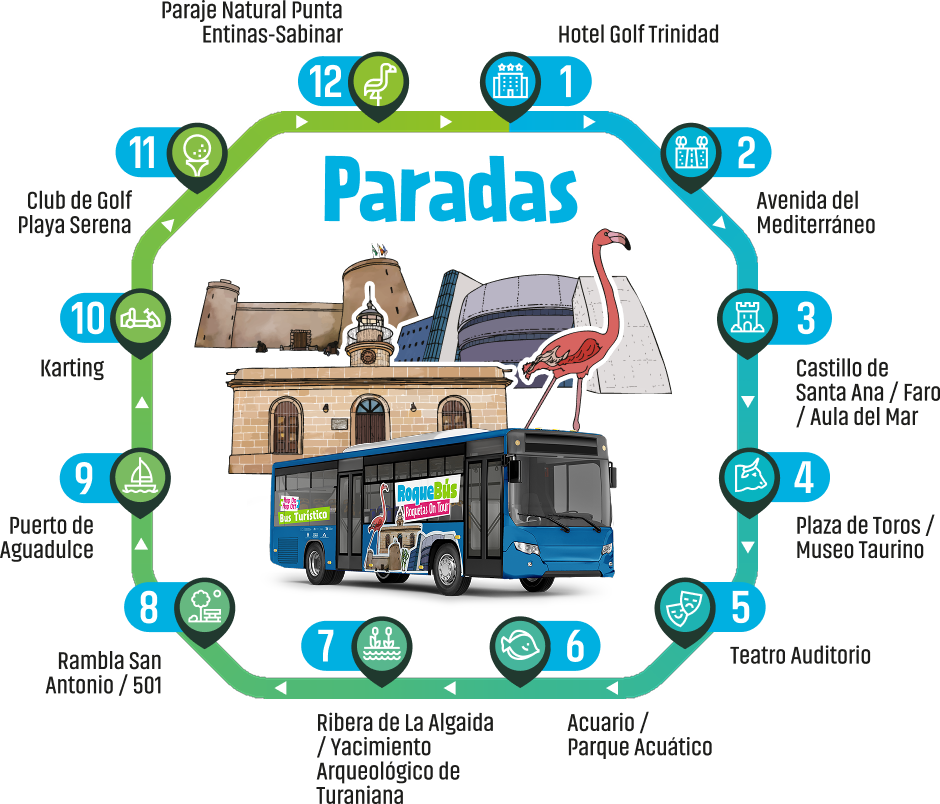
Il nostro itinerario completo passa per i principali centri di interesse turistico, commerciale e culturale della città. Goditi un percorso di 90 minuti con 12 fermate in punti di interesse e una capacità per 45 persone.

Servizio gratuito per minori di 6 anni
Audioguide incluse in 5 lingue
Accessibile alle persone con mobilità ridotta
Zero emissioni CO₂
Fermate Roquebús, percorso circolare
Located right in the hotel centre of the Roquetas de Mar Urbanization, this stop is the starting and ending point of every Roquebús route.
From this stop we recommend visiting the seafront promenade and Playa Serena, and it can also be a starting point for routes to Punta Entinas-Sabinar and Cerrillos beach.
It is a key area for shops, restaurants, hotels and leisure.
The Urbanization was planned in 1967 along the coastline, on land that had belonged to Unión Salinera, and was created under the law on Centres and Areas of National Tourist Interest of 1963.
Currently in the Urbanization area there are 31 hotel establishments, including one 5* hotel, twenty 4* hotels, five apartment-hotels, three guesthouses and three hostels. In addition, there are 17 tourist apartment complexes, a campsite, a holiday residence, a youth hostel and a Camper Park.
From this stop we recommend visiting the seafront promenade, the Urbanization beaches and Playa Serena, the Church of the Winds and the Tourist Office.
In this area there is a large number of hotel establishments, shops and cafés, ice cream parlours, restaurants, bars and beach bars.
The Roquetas de Mar Urbanization is the area with the greatest tourist development in the municipality and, until the mid‑20th century, it was mainly farmland and small cultivation areas. With the development that began in the 1960s, this area was declared of National Tourist Interest in 1967, with the Mediterráneo Bay Hotel, built in 1970 and opened in 1972, being the oldest in the Urbanization.
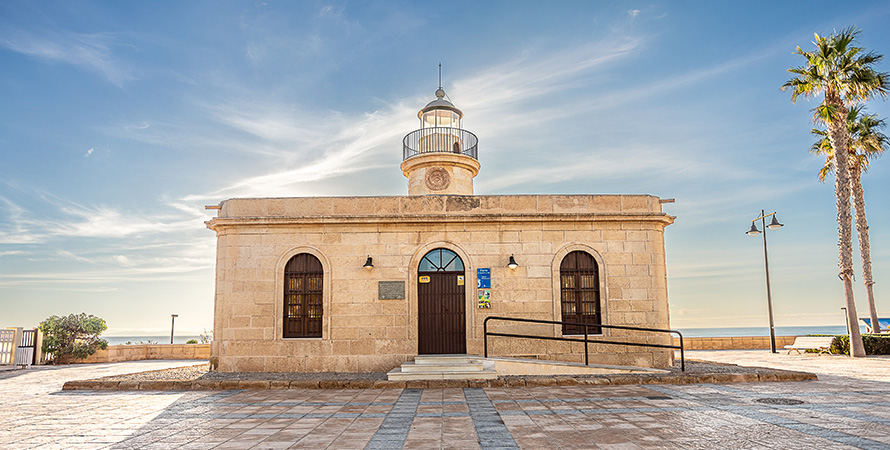
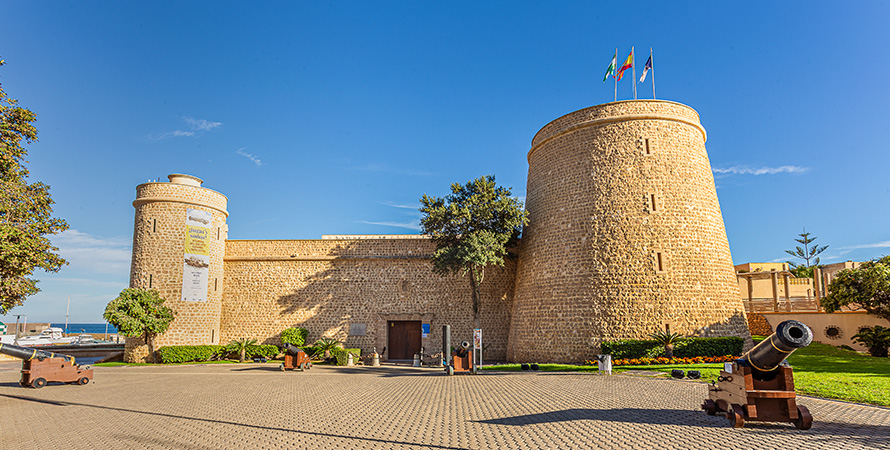
At this stop we can enjoy the highest concentration of cultural heritage on the route.
We recommend visiting the Lighthouse, the Castillo de Santa Ana and its surroundings, the Aula del Mar, the fish and leisure harbour, as well as the Bajadilla and Romanilla beaches, both with accessible areas.
The harbour is also an ideal place to enjoy water sports and its restaurants, where you can taste products from the sea and the land of Roquetas de Mar, as well as its leisure venues.
This stop is the closest to the historic centre of Roquetas de Mar.
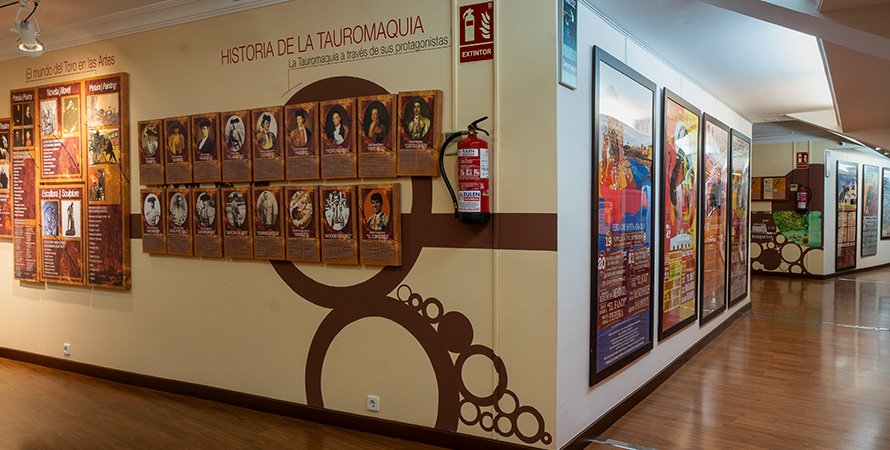
From here we recommend visiting the Plaza de Toros of Roquetas de Mar and its Bullfighting Museum, as well as Parque de los Bajos, which has a library, children’s playground, dog park and skatepark.
In addition, from this stop we can head towards Plaza de la Constitution in Roquetas, where we can visit the Casa Anita Museum and, along the way, enjoy the Mercado de Abastos to sample products from the sea and the market gardens of Roquetas de Mar.
This stop is located in front of the Teatro Auditorio of Roquetas de Mar, a cultural hub not only locally but for the whole province, and the second largest in all Andalusia, offering an international programme.
Here you can also enjoy restaurants, bars and cafés where you can spend pleasant moments, and visit the Gran Plaza Retail Park in Roquetas.
It is also close to the beaches of La Romanilla and Las Salinas.
From this stop you have direct access to the Aquarium Costa de Almería, a place to visit with the family where, through its four zones, you can enjoy the seabeds of the Amazon, the Coral Reefs, the oceans and the Mediterranean Sea. A highlight is that you can touch rays in their tank, dive among sharks or feed the koi carp.
From this stop you can also access the Mario Park water park, an ideal place to enjoy the summer months, with attractions such as Lago Azul, Río Bravo, Ciclón, the kamikaze slides and children’s areas. There are also organised activities and food services. It is open from 13 June to 7 September.
From this stop you can also access Las Salinas beach and the surroundings of Ribera de la Algaida and Turaniana.
From this stop we can access the surroundings of Ribera de La Algaida and the Archaeological Site of Turaniana.
Ribera de la Algaida, made up of wetlands, is an ideal area for walking, cycling routes, enjoying a swim at Playa de los Bajos and La Ventilla, or snorkelling at the Posidonia Barrier Reef.
On clear‑water days, it is also possible to enjoy the Posidonia Barrier Reef without getting wet, from the viewpoint located at this site.
From this stop, already in Aguadulce, we recommend visiting the Aguadulce seafront promenade, Aguadulce Beach, the 501 Leisure Centre and the Tourist Office on Avenida Carlos III.
Aguadulce takes its name from the springs that used to emerge on the seashore and it was once an area of farmhouses and inns, but in 1964 it became Spain’s first Centre of National Tourist Interest. That boom turned it into the important hub it is today.
We are in Aguadulce’s main leisure area. From here you can visit the entire Aguadulce seafront promenade and all its leisure venues, restaurants and beach bars, together with its beach, which has all services and an accessible area.
From here we also reach the port of Aguadulce, a marina that is also a leisure area with restaurants, cafés and night‑time venues.
The port of Aguadulce is also the main area for water activities, with companies offering coastal boat trips or scuba diving.
Near the port you will also find the Fuente Origen, the spring that gave Aguadulce its name.
From this route we can visit the colonisation village of El Parador and also enjoy Karting Roquetas de Mar.
The Roquetas karting circuit has some of the most advanced and modern facilities in Europe, both in terms of design and size and its computerised timing and remote stop systems. With 860 metres of track and a 100‑metre straight, it is ideal for enjoying with friends.
El Parador de las Hortichuelas was created as a colonisation village developed between 1954 and 1967 by the National Institute of Colonisation. Despite urban development, it is still possible to enjoy some of its original features, such as its church.
At this stop we are in front of the Playa Serena Golf Course, a course open 365 days a year. With 18 holes and designed by Peter Allis and Ángeles Gallardo, it is an ideal place to enjoy this sport.
It is characterised by wide fairways, 9 lakes and greens that are well protected by carefully designed bunkers. It is listed as one of the flattest courses in Spain and has a level suitable for the organisation of major competitions.
In addition, from this stop we recommend visiting the colonisation village of El Solanillo, although you will need private transport or public transport such as a taxi.
El Solanillo is a perfectly preserved example of the agrarian colonisation villages created by the National Institute of Colonisation in the 1950s and 1960s.
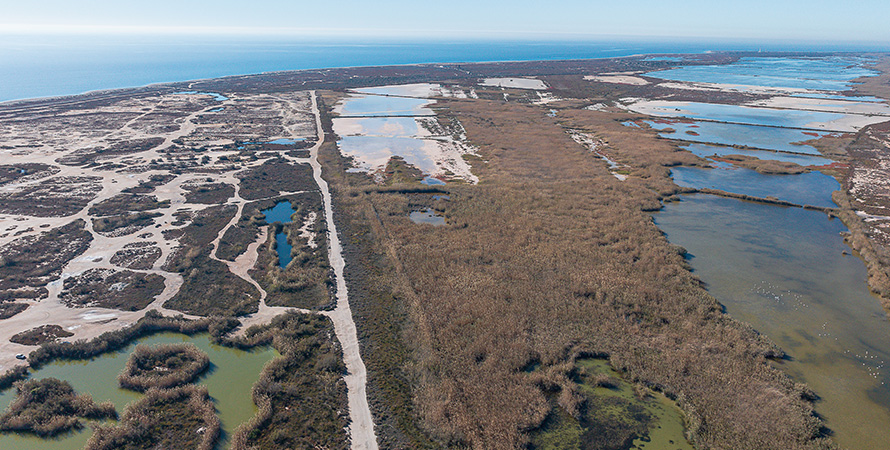
The last stop on this tour takes us to the edge of the Roquetas de Mar Urbanization and the Punta Entinas-Sabinar Natural Area.
From here we recommend visiting, in addition to the Natural Area itself, Playa Serena and Playa de Cerrillos, located within the area, where you can enjoy the sea on a virgin beach where naturism is also allowed.
If we walk through this natural area, between dunes and wetlands, we will reach the Torre de Cerrillos, a Nazari‑origin tower from the 14th century that marks the boundary between El Ejido and Roquetas de Mar.
Scarica opuscolo informativo
Individua le fermate sulla mappa
Acquisto dei ticket e orari

Hotel Golf Trinidad
(Itinerario circolare)

90 minuti

4 partenze

Mattina
partenza 10:00
partenza 12:00
Pomeriggio
partenza 17:00
partenza 19:00
Uffici del turismo Roquetas de Mar.
Avenida Mediterráneo, 2
Uffici del turismo di Aguadulce.
Avenida Carlos III, s/n
Sul bus stesso
Audioguide Turistiche Roquebus
Scopri i 20 luoghi più emblematici di Roquetas de Mar con le nostre audioguide turistiche. Ogni fermata del bus elettrico include informazioni storiche, culturali e patrimoniali sulle principali attrazioni della nostra città. Disponibile in cinque lingue.
Contatto
Ufficio del Turismo. Urbanización di Roquetas de Mar
Av. Mediterráneo, 2, 04740 Roquetas de Mar, Almería

Ufficio del Turismo. Aguadulce
Aguadulce. Avenida Carlos III, s/n
Impegnati negli Obiettivi di Sviluppo Sostenibile
Questo progetto contribuisce attivamente al miglioramento dell’ambiente e alla sostenibilità della nostra comunità.